Some of the best souvenirs start with a single cue from the place itself, a floor tile, the curve of an arch, the twist in a piece of ironwork. When you distil one detail into a repeating motif, your products stop feeling generic and start feeling rooted. Visitors recognise it. Staff can talk to it. Your range gains a quiet confidence.
Start with one thing
Pick a feature guests already notice on their way in. Stand square to it and take a clear, well-lit photo. Grab a second shot at 45 degrees so you remember how the shadows fall and what the texture actually feels like. That’s enough to begin.
Turn detail into design
Trace the shape simply, think stencil rather than sketch. Build a square repeat tile where the edges meet cleanly, then test a second version at a smaller scale. Keep the palette disciplined: two colours you can literally see in the building (stone, patina, brick, slate) and one warm accent. Before you fall in love with the artwork, mock it on curves and flats. Bottles and mugs don’t forgive fussy edges around shoulders and handles; notebooks and totes love edge-to-edge.
A tidy three-piece capsule
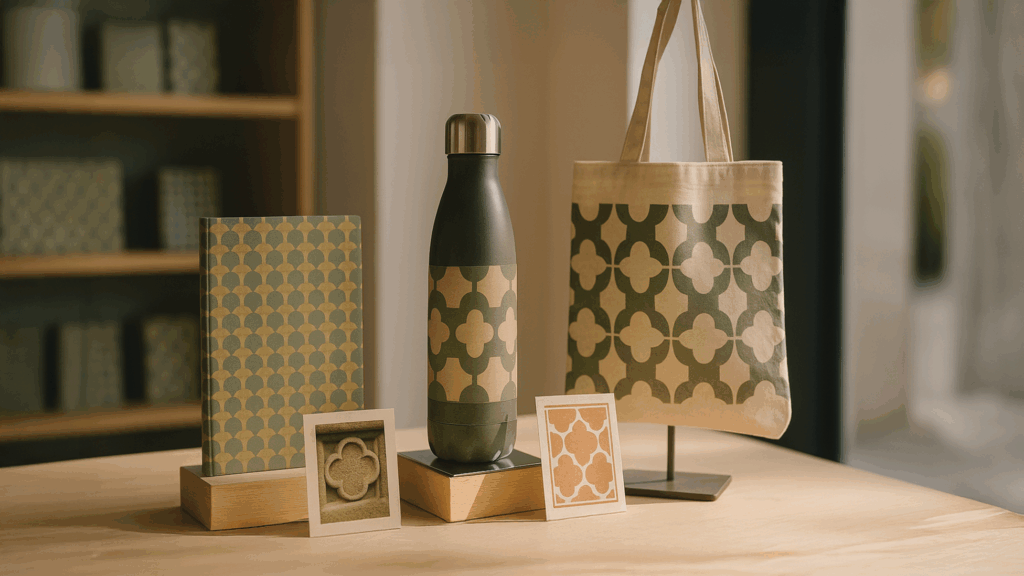
Lead with a wrap-around bottle that carries the hero scale of the motif in a seamless band. Pair it with an A5 notebookin a micro repeat for a calmer read. Add a folded tote that shows the bold repeat front and a subtler back. Same palette across all three.
Dress one small table
Keep it calm. Two riser heights for the bottle and notebook; the tote on a simple stand. Use soft daylight from the side and a small mirror riser under the bottle for a controlled glint, not glare. The story sits in a single postcard next to the products: on the left, the photo of the original detail; on the right, the repeat tile you built from it. Anyone reading that pairing understands the whole idea at a glance.
How to talk about it
You don’t need much copy. One sentence does the job: “A quiet repeat inspired by the [building name] [feature] you walked past today.” On social, show the move from detail → trace → tiling → a slow spin of the wrap-around bottle. Six to eight seconds is enough.
Keep it cohesive
Add new items only when the first three prove themselves. Stick to the palette you set at the start. Use one repeat scale per product so the table feels composed rather than “matchy.”
Tiny checklist
-
Capture one clear reference photo (plus a shadow/texture angle).
-
Build one hero tile and one micro tile from that single detail.
-
Launch one calm table with a bottle, notebook, and tote, nothing extra.
When a visitor recognises a cornice curve on a bottle or the rhythm of tiles on a notebook, the souvenir becomes more than a purchase. It becomes this place, this visit. One detail is all it takes.